
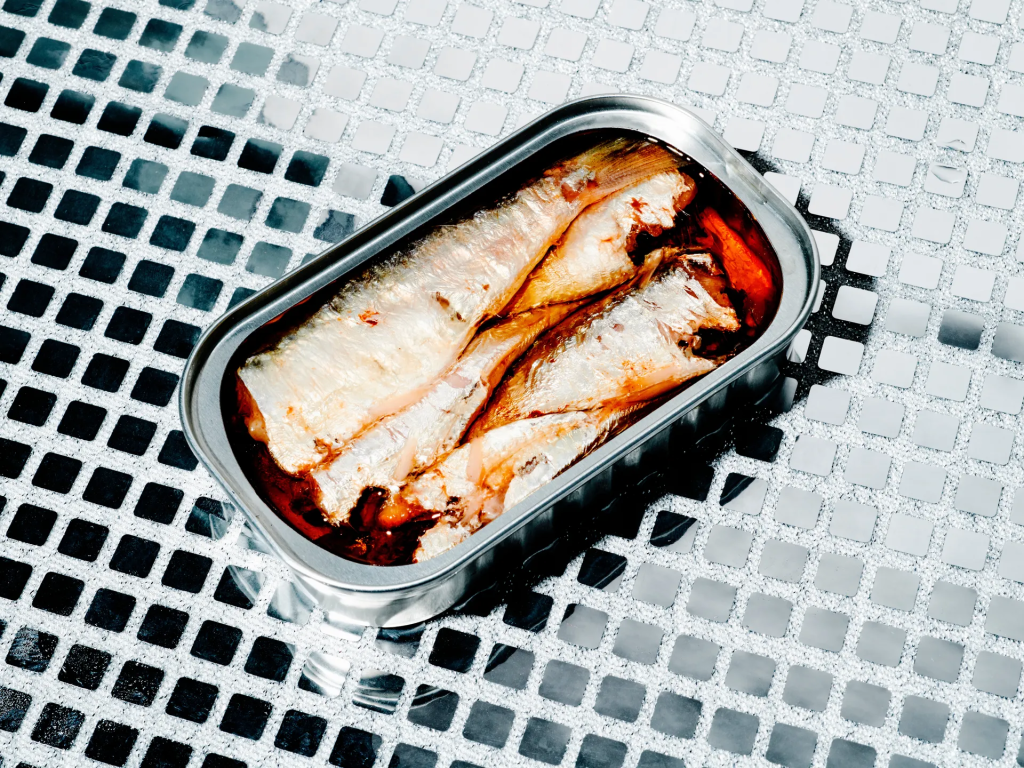
Forget that viral carrot salad: Sardines—the tiny, stinky fish your grandmother probably stocks in her pantry—are the newest beauty food. These days, they’re heralded as “nature’s skin care,” “nature’s multivitamin,” or even “nature’s Botox.” “It’s definitely a big TikTok trend,” Shira Wieder, MD, an attending physician at Montefiore Einstein and assistant professor of dermatology at the Albert Einstein College of Medicine, tells SELF.
Creators pushing the tinned treats claim that eating a few a day can bestow “glass skin,” a K-beauty pillar and coveted aesthetic that involves a dewy, almost translucent complexion. Jacqueline Vignona, a recipe developer with 68,000 followers, deems them “the secret to glowing skin” in one TikTok demo’ing how to make “sardine glow salad.” Yet another influencer, @ally.renee1 (1.4 million followers), declares that “maturing is realizing sardines are the TRUE looksmaxxing product” as she eats them atop potato chips.
If you follow online fads at all, the current sardine obsession makes a lot of sense: Combining three separate social media crazes—tinned fish, eating your skin care, and girl dinner (yes, people are making sardine-centric grazing boards)—into one, sardines represent a perfect storm for internet virality. But is the hype surrounding their beauty benefits actually legit? Here’s what to know before you swallow the hoopla hook, line, and sinker.
Yes, sardines are good for your skin.
While sardines contain plenty of nutrients, including protein, vitamin D, and calcium, omega-3 fatty acids are primarily responsible for the famed skin health benefits. These are “essential, anti-inflammatory fats that we need to consume from food,” according to Anthea Levi, MS, RD, a Brooklyn-based health writer and the founder of Alive+Well Nutrition, since the body can’t synthesize them on its own. In particular, sardines are especially rich in two major types of omega-3s: eicosapentaenoic acid (EPA) and docosahexaenoic acid (DHA), Dr. Wieder says.
Within the two outer layers of your skin, the dermis and epidermis, omega-3s “modulate inflammation and may help reduce collagen damage resulting from UV exposure,” Levi says. Put another way, they reduce the risk of premature skin aging stemming from the UV radiation in sunlight, according to Dr. Wieder (not to mention the risk of skin cancer). In addition, they also serve other critical functions, like protecting heart health, preventing age-related cognitive decline, and promoting fetal brain development during pregnancy.
Because of their skin-friendly MO, eating sardines can act as a “preventative mechanism,” Dr. Wieder says. In other words, they won’t make your skin look better; they’ll prevent it from looking worse. In the case of dark spots, for example, eating sardines “is not going to reverse pigmentation, but it can potentially help prevent [further] pigmentation caused by UV radiation,” Dr. Wieder explains. (Which is not to say you should take this as an excuse to skip your daily SPF: Speaking as a dermatologist, Dr. Wieder says, sardines are “not a good replacement for sunscreen.”)
Sardines’ anti-inflammatory properties can also make them effective at treating some other skin concerns, like acne and certain inflammatory skin diseases, according to Dr. Wieder. Now, “is it as effective as medications that we use for acne? Not necessarily,” she says. “But if you’re after a more modest response…I could absolutely see the benefit.” Some research suggests omega-3s may also be beneficial for psoriasis, rosacea, and atopic dermatitis, among other conditions, though the evidence is mixed.
Finally, sardines can also boost skin hydration and speed wound healing. “Consuming sufficient omega-3s also helps keep the skin moist,” Levis says of the former. “This is why an essential fatty acid deficiency is often characterized by dry or inflamed skin.”
Are sardines better than other foods for skin health?
Great as they sound, sardines are hardly the only food (or even fish) to offer a fair amount of omega-3s. Other fatty fish species are also famously packed with the nutrient, including salmon, Atlantic mackerel, anchovies, and herring, Levi says (not to mention plant-based sources like walnuts, chia seeds, flaxseeds, hemp seeds, and their corresponding oils). So why the hype around sardines specifically?
Here is where the TikTok claims may actually check out: Compared to other omega-3 fish sources (mackerel, say), sardines really are “a better delivery mechanism,” Dr. Wieder says. Specifically, she explains, they have a higher concentration of EPA and DHA than other fish oils, translating into “better permeation through the human skin” and, in turn, “more activity against the sun [and the resulting] UVB damage”—hence their popularity in the skin care world.
How often you should eat sardines to reap the benefits
Data suggests that you need to consume five grams of fatty acids daily for 10 to 12 weeks to see an improvement in your skin’s ability to defend against harmful UV rays, according to Dr. Wieder. “So it’s not [for] occasional use,” she says.
To put this in perspective, five grams is a pretty high dose: It translates to around five tins of sardines per day, since each 3.75-ounce container averages around 0.9 grams of EPA and DHA combined—a daunting portion for almost anyone.
For this reason, Dr. Wieder is skeptical about TikTok claims that you can notice a difference within a few days of increasing your sardine intake. “If you look online, you’ll see articles [saying], ‘I took it for three days and I’m all better,’” she says. “That’s not what I would typically expect,” particularly as skin cell turnover doesn’t happen that quickly.
And while you can consume those five grams of fatty acids in the form of sardines, whether you should is an entirely separate question. Eating five tins of sardines per day could pose health risks. While sardines aren’t high in mercury thanks to their low position on the marine food chain, they can contain elevated levels of other heavy metals, especially arsenic. What’s more, tinned fish tend to be heavy on sodium, since they’re packed in salt as a preservation method, so overdoing it can introduce an excess and strain your body, “particularly for people who have high blood pressure and heart disease,” Dr. Wieder says. Finally, sardines are also high in chemical compounds known as purines, which can indirectly “trigger gout in people who are prone to it.”
Potential health risks aside, eating five tins of sardines per day probably isn’t even feasible for most people. “With how they taste, not everybody can achieve that kind of dose,” Dr. Wieder points out.
With these barriers in mind, Dr. Wieder has one suggestion: If you’re shooting for five grams of fatty acids per day, taking the equivalent in fish oil supplements is a better bet—a rare exception to the typical food-first approach. (Even so, you still might experience some side effects, like a fish taste in your mouth and nausea.) Needless to say, five tins of sardines is “not really healthy,” Dr. Wieder says, referring to the sodium content. If you’re still hell-bent on the fish themselves, use caution. Remember, “not everybody is a good candidate to eat so many sardines, so it should be done thoughtfully,” Dr. Wieder reiterates—and if you have any specific risk factors, discuss with your primary care doctor beforehand.
Ultimately, two to three servings of sardines (or another fatty fish) per week, as Levi recommends, is a far more realistic and advisable prospect than five tins per day, even though it won’t take you across the five-gram finish line. And even if you do start hitting that five-gram mark consistently, whether through sardines or supplements, don’t expect some big, dramatic transformation, according to Levi. “Unfortunately, eating sardines probably won’t translate to obvious, visible changes in the skin. Sardines supply incredible nutrients that can support skin health, but don’t count on them alone to eliminate wrinkles or undo sun damage,” Levi says. If only—but at the end of the day, no food is a magic bullet, not even TikTok’s darlings.